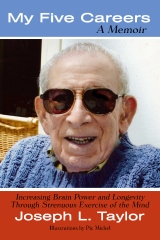

My Five Careers: A Memoir
Increasing Brain Power and Longevity
Through Strenuous Exercise of the Mind

By Joseph L. Taylor, Pic Michel

IN MY FIVE CAREERS, ninety-four year old Joseph Taylor offers the keen observations of a trained professional, using plain everyday language, concerning how the centralities of work, marriage, friendships, music and skillful management of chance events, have contributed to retaining his intellectual acuity and to promoting longevity. He notes that his life-long pursuits coincide with contemporary research findings on maintaining brain power and achieving a long life.

Taylor suggests many brain-boosting post-retirement activities, and offers insightful comments on the practice of psychiatry, the common denominator in the many different talk therapies, hypnosis, the experience of marching with Danny Kaye in an Ivy League University procession, why he believes that child abuse will not be eradicated in the foreseeable future, and why sports is perhaps the most honorable enterprise in American life.

Thirty New Yorker-style cartoons, produced in collaboration with artist Pic Michel, take a wry, witty look at Taylor's significant and not-so-significant life. A selection of his previously published personal essays, short stories, a one-act play, poetry, and easy-to-read articles published in professional journals follow the narrative.

Preview this book:
List Price: $14.95
About the author:
Following careers in clinical psychology, social work, teaching at the University of Pennsylvania, and writing, Joe's last job (age 80-88) was developing programs for the world-class Peabody Essex Museum.  Throughout his life Joe has consistently found every end was also a beginning. 

Sadly, Joe made hs transition from this life shortly after My Five Careers was published.  His wisdom however, is imperishable.  For more information about Joe, visit his blog joe1915.blogspot.com Scroll down to read what was shared at Joe's Memorial Service
Add to Cart
HeartStudio Books is a registered trade name of The Heart Studio, LLC

Page last updated February 2010

Questions?  Email
View Cart
Publication Date: Nov 16 2009
ISBN/EAN13: 0578042401 / 9780578042404
Page Count:  294
Binding Type:  US Trade Paper
Trim Size:  6" x 9"
Language:  English
Color: Black and White
Related Categories:  Biography & Autobiography / Social Scientists & Psychologists
Joe Taylor Memorial Service

On March 21, 2010 Family and Friends of Joseph Taylor gathered in Salem Massachusettes to remember Joe's life.  Below are the stories of those who admired, worked with, and loved Joe.


Eulogy for Joseph Taylor  Yosef ben Moshe v’Batya

Good afternoon!   I am Rabbi Steven Fink of Temple Oheb Shalom in Baltimore.  I am grateful to Rabbi David Meyer of Temple Emanuel for allowing me the privilege of speaking from his pulpit for a second time.  I was here four years ago to eulogize Gerry Taylor.  You must be asking yourself a question, “Why is a rabbi from Baltimore speaking about Joe?”  Allow me a few minutes to explain.
I have known Joe my entire life.  He grew up in a house on Early Street in Morristown, New Jersey, just around the corner from my grandparent’s home on Speedwell Avenue.  He and my dear uncle, Herman Rosenberg, were best friends ever since the seventh grade.  They would walk to school together, hang out on my grandmother’s porch with another future distinguished Jewish communal service professional, Morris Fine, and play basketball after school.  My uncle and Joe went to Drew University and remained staunch friends their entire lives.  Gerry and Joe and my uncle and aunt saw each other regularly.  My uncle was so proud of Joe and would often tell me about his accomplishments. When my wife Sally and I moved to Elkins Park, Pennsylvania in 1979 for my first pulpit, I technically became Joe’s rabbi.  In truth, Gerry and Joe became our mentors and surrogate parents. We had dinner at their home several times a month and dined with them on Sunday evenings at the Darby Wheel Pump Inn, a comfortable old place that dated back to the Revolutionary War.  Joe and Gerry became our confidants and guides as we struggled to understand congregational and Jewish communal life.  They were the first ones we called when our first child was born.   We relied upon them for parenting advice, which proved to be fairly sound as our three grown children seem to be fairly well adjusted. As time went on and we left Elkins Park, we missed their company very much.  We kept in touch and saw them whenever we returned to the East Coast.  Joe and Gerry were role models for us, exemplars of how to live nobly and well.  Joe became our prime example of how to be a human being.  Joe never stopped growing, learning, and changing, adjusting constantly to the challenges of the aging.  Joe never grew tired of life.  We never grew tired of being with Joe.  He was one of the most fascinating and unusual men we have ever met.
Joe could have been the protagonist in a Saul Bellow novel.  He was a Jewish intellectual who deeply cared about his people and his community.  He worked throughout his entire career to make our world a better place.  Thousands of children had healthier and more fulfilling lives because of him.  Yet Joe was more than a dedicated professional. Joe achieved fame as a social worker, agency executive, teacher, children’s advocate, violinist, athlete, poet, play write and essayist.  He was a wonderful husband to Gerry for sixty-four years and an exemplary father to Barbie, John, Paul and Claudette, a proud grandfather to Daniel and Ethan, and a dear friend to so many of us.  Above all, he was an astute observer of the human condition.  He found people to be endlessly fascinating.  He wrote in 1985, “But to know what life will be like in the 21st century!  To know if there will be a cure for cancer, if man will live in space and if new songs will ever sing again.  To know how high and how low women’s skirts will go and who the sex symbols will be.  What will be the outcome in South Africa?  Will the Mafia ever be wiped out?  Will a Super Bowl game ever live up to its promise?  And how will history treat President Ronald Reagan?”  Fortunately, Joe was able to live twenty-five years longer and at least learn what happened in South Africa. 
Joe’s parents, Max and Bertha, came to this country from Russia and Poland.  They adored their only son and wanted him to live the American Dream.  They encouraged him to study hard to become proficient at tennis.  When he was in seventh grade, they gave him a violin which he practiced half an hour every day.  What first may have been a chore became one of the great loves of his life.  Joe graduated from Morristown High School in 1933, in the midst of the Great Depression.  He yearned to go to college and was able to commute to Drew University in Madison, New Jersey.  In order to save money, he often walked home rather than spend a nickel for the trolley.  Joe was a student-athlete. He was Drew’s number one tennis player.  As team captain in his senior year, he led the team to its first undefeated season, all the while excelling in academics and playing in the school orchestra.  He was now ready to begin his adult life.
Joe was not an observant Jew, but in his efforts to better human life he was Jewish to the core.  Joe took the admonitions of one of history’s best known authors to heart.  The biblical poet, Ecclesiastes or Kohelet, taught us (9:9) to “Eat our bread in gladness and drink your wine in joy…enjoy happiness with a woman you love all the fleeting days of life that have been granted you under the sun…whatever it is in your power to do, do with all your might.”  He thoroughly appreciated every meal cooked by Gerry, Barbie, or John.  He loved Gerry intensely.  He once wrote that passion, affection, companionship, and dependence are the four qualities necessary for a successful marriage.  He and Gerry had these in abundance. Whatever he did, he did with all the talent and energy at his command. Joe brought meaning into the lives of so many and led a meaningful life.  There will not be another like him.
Joe met Gerry when he was a student at Case Western University School of Social Work and she was a social worker in Cleveland. They married in 1941 and were best friends and partners for sixty four years.  Joe began his career that same year.  He never really retired.  He just transitioned from stage to stage.  He gave each of his five careers all the energy and expertise he had.  The couple soon moved to Chicago where they both were case workers, then moved to Long Island when Joe became an Army psychologist at Mason General Hospital in Brentwood, Long Island.  After the War was over, they moved to Cincinnati where Joe was a supervisor in the VA’s mental health clinic.  Then in 1948, Joe received his big break.  He became Executive Director of Jewish Family Service in St. Paul.  He was a superb agency executive and was applauded for his work in resettling refugees and cooperating with rabbis in meeting the mental health needs of the Jewish community.  Joe’s success in St. Paul brought him promotion to the major leagues.  In 1957, the family, now including Paul and Barbie, moved to Philadelphia where Joe became Executive Director of the Association for Jewish Children.  Joe was at the top of his field.  He supervised an agency with a staff of almost a hundred and delivered services to children and adolescents in a variety of settings.  He published thirty-three professional articles and co-authored a book.  He served as a leader of his professional organizations and earned several major awards for professional excellence.  Joe worked on behalf of others with all the power at his command.  When he left this position at the age of sixty nine, he became a lecturer at the University of Pennsylvania.  His course on social policy was voted the best class in the entire university.  Joe taught, wrote, and played tennis and violin while Gerry cut back on her private practice.  In 1994, yearning to be closer to their children, the octogenarians moved to Salem and began the next and perhaps most enjoyable part of their lives.  
Joe took being a father quite seriously.  He wrote in 1988, “The true pleasure in being a father comes when …a father is simply happy with his children for what they are, for what they have done, for how they have grown in the doing and for having managed and endured a life that is different from all other lives.  This is the afterlife of fatherhood, and that is why being a father is one of the few things a man can take seriously as long as he lives.”   Joe so enjoyed being part of his children’s lives.  He became friends with their friends while he and Gerry became part and parcel of this community’s life.  Joe’s writing flourished.   He became a well recognized and noted award winning author on the local literary scene. He taught creative writing at Endicott College.  He created a well read blog.  He wrote a one act play about the Lincoln-Douglas debates.  He continued practicing the violin and playing in chamber groups.  He was a sought after volunteer and was praised for his work at the Peabody Museum. 
When Gerry was ill, Joe tenderly and lovingly cared for her.  Though he missed her very much and mourned for her deeply, he would not allow life to pass him by.  Joe enriched the life of this community and made our world a better place.  He continued to grow and flourish until the very end.   Joe was a noted observer of human behavior, a professional committed to human betterment, a poet, artist, athlete, and musician.  He was a wonderful husband, a fine father, grandfather, and friend.  He took pleasure in his food and drink, loved Gerry intensely, and lived completely each and every day.  Joe was a blessing to our world.  We will miss him very much.
Y’hi Zichrono Baruch- May the memory of Joe Taylor always be a blessing.

Amen                            

A Unique Man   Gloria Hochman

Back home in Philadelphia, I have a thick file stuffed with things that Joe wrote and things he told me.  I call the file simply:  Joe Taylor, An Extraordinary Man.  In a moment, I’ll share with you a couple of things from that file.

When I met Joe, I was a young mother of  two-year old daughter.  He was Executive Director of the Association for Jewish Children, a prestigious multi-service child care organization that placed some children in foster care, some in adoptive families, and ran group residences for older children who were too troubled to go into private foster homes.  

All of you have, some time in your life, had the experience of meeting someone and you just clicked instantly.  That’s the way it was with Joe and me.  I went to him looking for a job in public relations, and I was thrilled when he hired me.  I could sense that while his main job at that time was heading this agency, that he had a subterranean calling, a sensitivity, a view of life, that I came to learn, he expressed through writing, some of which all of you here have had the pleasure of reading.  But I had no idea then that this was the beginning of a friendship that would last more than four decades.

Joe was a talented and visionary executive director and liked to work with people who caught on quickly.    So many times, I would watch Joe at meetings of his board of directors or his staff or just in a group of people.  He would sit there quietly while they would argue about an issue or try to make their points.  And then, Joe would say three sentences that summed up everything, that cut away all the debris and got to the heart of whatever the issue was.  And everyone would look at each other as though to say, “But of course.  Why didn’t we think of that?”

Joe was incredibly prescient.  At a time when adoption was only for babies, Joe believed that some of the children in foster care—those who were older, those who had emotional problems or physically disabilities—could be adopted if only people knew about them.  

In fact, in the late 70’s, there was Allison, a little girl born with Down syndrome.  Her parents were an attorney and his wife who didn’t think they could take care of her.  And that was a time when children with Down syndrome were not cared for at home; they went to institutions.  But these parents wondered whether anyone would want to adopt Allison.  They called 13 agencies, and only Joe Taylor said he would try.  It took three years, but his agency finally found  a home for Allison with a single woman in West Virginia.  The woman was a lesbian, another first for Joe.  Fifteen years later, Allison returned to a dinner in Philadelphia where she told an audience of 300—I want to thank all of you because without you I wouldn’t have a family.  The room was so quiet you could hear a handkerchief fold.  This is an example of the kind of thing Joe did.

Joe wrote the initial proposals that provided the seed money for an organization that turned, years later, into the National Adoption Center, which has found families for more than 22,000 children, none of which was a healthy baby.  So this, too has become part of Joe’s legacy.

Through the years, Joe and Jerry became treasured friends of my family.  They came to our house for Passover and for Rosh Hashunah.  And this year, with Passover coming up next week, their absence at our table will continue to be palpable.

Having been friends for so long, you can imagine that we have been through many of life’s traumas and triumphs together.  We shared with them the bleak times when Paul was in India and they went through long periods when they didn’t know exactly where he was.  And the happy times when he returned and when he and Claudette came together because of a lost bracelet, when their two sons were born.

And Barb, of course, was the light of his life.  There was not a time I talked to him, including two days before he died, that he didn’t tell me how beautiful Barb is, how kind and caring and generous—how devoted Barb and John were to him, how their friends became his friends, how he was included in their parties and dinners and social life, how happy he was that he and Gerry had moved to Salem to be near their children.
There are three things from Joe’s file that I’d like to share with you.   Two are things he told me:  Once he said, “You know the first jolt you get when your kids are growing up—the first time you realize that they have thoughts you never knew they had—like a belief in reincarnation or transcendental meditation.  Up until that jolt, you feel as though you know everything about them.  We have to learn to rejoice in their separateness.”

And once, after a long lunch where we looked at strategic planning for the agency, he told me, “Gloria, one day, not too far in the distance, some women are going to be breeders.  They will have babies for women who can’t.”  I looked at him and said, “Joe, I know you have incredible vision, but this time I think you’ve gone too far.”  And, of course, many years later, here came Mary Beth Whitehead and baby M, the first and most publicized case of surrogate parenthood.

Those of you who knew Joe and Gerry know that they had an incredible love affair throughout their lives.   This is what he once wrote about it when he was in his 70’s.

    Walking along the streets of my city, many pretty young women pass my way—and they do not even see me.  The subliminal recognition that I am too old for them erases me from view.

    But suppose the young women who pass me today knew that I once bought a camellia corsage for a girl, that we rod in the rumble seat of a 1929 Ford and that I ate apples from a tree near school to save lunch money for the date?  But there are better reasons why the next girl who passes should look at me.  I know something she does not know.

    I could tell her that one day the most exciting dream of her life will come true.  In the dream, she is riding the most beautiful horse in the world.  It is running faster than any horse has ever run.  She is ecstatic and believes the ride will last forever.  But when the dream comes true, she finds that the horse, so dazzling at first, is a poor finisher.  The horse begins to falter and limp.  The road that was so smooth suddenly becomes a steeplechase with obstacles.  She can quit the trip in disgust—about half the other riders who have this dream quit—or she can learn the ways to make the horse stronger and finish the trip.  The new pace will not be as breathtaking.  Its joys will be more solid than soaring, but on the trip she will find deep affection and warm companionship.  Actually, what she will find is love.

I want to thank Barb and John for giving me this chance to tell all of you, who think Joe was very special that I think so too.  I will always miss reading his words and hearing his voice.    But then, there is that file:  Joe Taylor:  An Extraordinary Man.


On Love and Marriage   Madalaine Pugliese

I decided on the topic of love and friendship for many of the reasons that we have already heard and will hear more about today. My comments address three kinds of love I think about when I think about Joe: 1) Gerry, 2) Food, and 3) Family and Friends. Thankfully Joe left his remarkable memoirs so that we can celebrate his thoughts quoting selections using some of his own words. 

However, I feel uniquely qualified to talk about these topics for a very special reason. Joe and his beloved Gerry shared a wedding anniversary date with my wonderful husband Carmen and I. We loved celebrating together -- and Joe had fantastic taste in campaign! Carmen and I can only hope that our young 32-year marriage will emulate the astonishing love affair that Joe and Gerry enjoyed for 64 years. 


1. Joe’s love for Gerry (quotes from My Five Careers)

“At the start of my second year of internship 1939, I was walking behind Gerry in an office corridor. She had beautiful legs. My hormones were working. I whistled at her. She turned around, instinctively. I said, “Nice girls don't turn around when a guy whistles.” As I recall, she did not reply directly to my remark, but we fell in step and chatted as we walked. I am certain my recall is correct, because I'm certain there is no man alive who does not remember vividly the beginning (and the pick-up line) of what becomes a life-long love.”

“I also remember vividly our first kiss and where it occurred. It was a Sunday afternoon in summer. We had gone for a drive along Lake Erie. Gerry stopped at a picturesque spot and we were looking out at the water. We have enduring fantasies about a first kiss, then it just happens and we cannot remember exactly. I was now happily in love!”


2. Joe’s love for Food

When I think about Joe I smile remembering his enthusiastic appetite for good food. Our last of many Thanksgivings together just this year was filled with amazing cooking efforts and Joe didn’t miss a bite! What a hearty appetite he enjoyed! He gave the most heartwarming toast ever, declaring everyone at the table “a loving family.”

I think about the time that Carmen and I invited Barb and Joe to a Red Sox game. What does this have to do with food you might ask? Well, we had the rooftop seats at Fenway Park that comes with a table for 4, your own waitress, and $100 of free ballpark food. Joe saw to it that we didn’t waste a penny and ate more than the rest of us put together. I think he still had a package of Cracker Jacks in his pocket when we went home. 
Then there was the time that we had Joe over for a Super Bowl party. Even though we planned plenty of food, it was incredible how much Joe put away. We were eating Italian sausage sandwiches with all the fixings. He probably ate 4 more sandwiches than anyone else. 

Once for his birthday gift we gave him a gift certificate for a home cooked grilled swordfish dinner, his favorite! He reminded us relentlessly until we set the date!
I don’t think I’ll ever shop at Costco without thinking of Joe and how much he enjoyed their rotisserie chickens. Sometimes I bought him two so he could share with a friend or neighbor, making sure he still had one of his own to stash away!

3. Joe’s love for Family and Friends
(quotes from My Five Careers)

Friends

“My friends were of enormous help (in my life) as well. Naming persons whose kindness has made one's life brighter and cheery is hazardous, for fear of omissions.”  Rather than trying to name names, I’d like to quote one of Joe’s favorites, Lincoln. 

Abraham Lincoln:

The better part of one's life consists of his friendships.

Just look at us all celebrating Joe Taylor today. It gives me comfort to believe that we together enriched Joe’s life with such meaningful friendships.

Family (from My Five Careers)

“As with most adult sons, Paul has not needed a father in the conventional sense for many years. We are good friends, and meet for lunch or coffee every week. He has developed a point of view about how to live one's life, based upon the concept of personal responsibility that could serve as a model for others. In 1988, he married Claudette, a beautiful, charming woman. I have a standing invitation to their home for dinner every Tuesday.” 
“They have two sons: Ethan, age sixteen and Dan, age nineteen. Ethan, a junior in a highly-rated prep school, is an outstanding student, a member of the National Honor Society, plays on the varsity tennis team, and is an excellent skier. Dan is a sophomore at the Massachusetts Maritime Academy, one of the highest rated colleges of engineering in the United States. He is gifted and creative in engineering.”

“Barb stops in daily, sometimes twice. She checks the refrigerator to see what I need, examines the list I made, shops, and drives me to doctor's appointments more than I want her to (I use taxis). Barb has many friends, for like her mother, she is a people-person; and like her parents looks twenty years younger than her age. Barb has a distinctive hairstyle that fans out in long curls, announcing her presence from far away. Through Barb's sponsorship, her friends have become my close friends. Among them there is often a birthday party, an anniversary celebration or a just-for-the-fun-of-it festivity. Barb is always upbeat and my spirit soars when I am with her.” 
“John, Barb's husband is a software engineer. John is a skilled cabinetmaker in the Federal style. To the untrained eye his chests, tables and other pieces are indistinguishable from authentic pieces of the Federal period. John is an avid fisherman in the local seawaters. In season he dives for lobsters, so in summer we eat lobsters as casually as others eat hamburgers.”

Barb, John, he loved you SO MUCH! 

I’d like to close with some quotes about friendship and love that I think well illustrate Joe. 

HENRY MILLER:

The one thing we can never get enough of is love. And the one thing we can never give enough of is love. Love doesn't make the world go 'round; love is what makes the ride worthwhile.

OSCAR WILDE:

Keep love in your heart. A life without it is like a sunless garden when the flowers are dead. The consciousness of loving and being loved brings a warmth and richness to life that nothing else can bring.

Joe’s life was indeed warm and rich because of his consciousness of loving and being loved.


Playing Tennis with the Net Down   Jean Monahan

At the start of his short essay, “Life as a Spectator Sport”, Joe wrote: “When I retired from my working life at seventy, it felt like I was playing tennis with the net down.” Joe relished the freedom of no rules or expectations throughout his retirement, which lasted over twenty years. A sentence later he says, “(at 90) now there isn’t even  a net….and living may soon become a spectator sport”. It’s remarkable to think that Joe Taylor ever worried about being merely a spectator. Like his wife, Gerry, Joe was an engaged, thinking, active citizen, with a kaleidoscope of interests and a surge of energy for the things he cared most deeply about.

I met Joe and Gerry 9 years ago. It was a gorgeous afternoon in June. Two weeks before, I had adopted a baby girl. I went to the Salem Athenaeum to give a poetry reading, and Gerry and Joe were among the small group sitting around the table. We connected initially because  of their interest in my adopted daughter…Joe told me he had worked  with adoption agencies during his time as Executive Director of Jewish Family Services in Philadelphia. We also connected through the poetry I shared that day. Those two threads, writing and parenting, were the hallmarks of our friendship, along with a shared zest for living.

While Gerry was alive, we frequently visited with both of them. They came to dinner at our house, we ate at their home…and sometimes we ate out. After Gerry passed away, my daughter Lilah and I continued the friendship. Joe was not just my friend, he was in a sense a kind of grandfather for my daughter. My own father passed away in April of 2002, and among my many heartaches was the realization that she would  grow up without a grandfather. But, instead, Lilah had both Joe and Gerry’s interest in her well being these last several years. Joe encouraged her interest in music, invited us to two operas, and attended a few of her piano recitals. He was generous in other ways, too. Every summer Lilah and I attend a heritage camp in Colorado, which is dedicated to giving internationally adopted children a sense of their heritage and  culture. Joe twice offered to help me with Lilah’s airfare out to the camp. His generous gesture made a big difference in our being able to attend. He was a steadfast friend to many people and we count ourselves lucky to have had him in our lives.

But let’s get back to the tennis game. In real life Joe was quite a tennis player. He was the number one singles player on the tennis varsity team at Drew University for four years in a row. Of course in his essay, Life as a Spectator Sport, Joe used tennis and the net as metaphors for how strong a player one is at the game of life. So let’s look at his life as a writer. Joe worked at the craft of writing over many years. He wrote essays, short stories, poems, a one-act play, and professional articles. He shared with me drafts of whatever he was working on, and I sometimes did the same. Many of us here heard him read what may be his most successful essay, called Love and Marriage, at the Athenaeum a few years ago.

And now we circle back to Joe’s concern that he might end up just a spectator in his late 80s and 90s. Joe’s dedication to working on his own writing not only set a fine example  of someone actively engaged with life, it also helped tie me to the  writing world during a time when I was unable to write much myself. He learned to use a computer, wrote at his desk many mornings, and as you will hear about shortly, and probably already knew, he kept a blog.
Probably the most enjoyable evening we ever spent took place almost exactly a year ago today, when we attended Salem’s second annual literary festival. We had a small bite to eat upstairs at the Hawthorne and then moved downstairs for the actual reading. Joe sat up front, soaking in the evening.

A photographer for the Salem Gazette took a classic picture of him:  he’s nattily dressed, arms crossed, listening intently. Joe was not a passive listener that night, he was a member of the profession, a writer. At the end of the evening he inquired of the organizers whether he might give a reading there when his book came out. He was still in the game, still a strong player, and he was winning.


The Journey of Joe's Memoirs   Pic Michel

As I begin I can hear Joe suggesting I open with a powerful first line, so there you have it.  When Joe Taylor invited me to tea the day after he bought one of my paintings at an opening in Salem, I had no idea with whom I was meeting.  He seemed like a nice elderly man and he was, but within moments of sitting down I became quite aware of his quizzical and analytical nature.  He seemed to almost interview me, and I happily answered all of his questions.  Here and there, he told me a little about himself, how he recently had lost his wife, how his daughter Barb helped him enjoy his life as a writer by getting him around to give readings from his book Out of My Mind.  Joe sent me home with an autographed copy.  I thought that was nice.

About a year later, Joe surprised me with a phone call.  He asked if I would consider collaborating with him to produce cartoons for which he would send me gag lines and descriptions that I would fulfill with illustrations.  I was curious and agreed to review some of his ideas.  That was the first of many ideas Joe proposed and shortly afterward I received the first manila envelope filled with pages of ideas for cartoons.  Joe later explained he had developed the desire to cartoon 20 years earlier, it just took him awhile to find someone to do the drawing.  At first it seemed like just a little fun to me, but from the outset, it was all business to Joe.

Every time Joe sent an envelope he would follow up with a call and ask what I thought.  One day I commented that he seemed to send a lot of cartoons in which an older man was wining and dining a younger woman.  He replied, “My dear, I am 93 years old.  Everyone I have dinner or lunch with is younger than me.”  It wasn’t until then that I realized the cartoons were reflecting his actual life.  Somewhere along the way, I told Joe I thought Out of My Mind should be available on Amazon.  I truly believed everyone should be able to enjoy his wisdom, that the essay Love and Marriage in particular, should be read at every wedding, and if a couple did not want to read it, they should not get married. 

That’s when I was privileged to see what a powerhouse Joe Taylor was -- that behind his nice elderly appearance was a man who not only could not resist picking up a challenge, but constantly created them and won as he matched wit with wisdom to make it happen.  Within days Joe asked me about self-publishing and set about going through the process.  Shortly afterward Joe stunned me when he called to report his progress.  He had no intention of simply republishing his first collection of writings, he was producing his memoir with the added intention of fleshing out and backing up data about what it takes to maintain mental acuity in a long life. 

Joe’s dedication and enthusiasm was infectious.  Over the next year he wrote fervishly, continued sending cartoons, proposed that they be a part of the book, and even test marketed them with friends to see which should be included.  Joe sent lists filled with checkmarks and deletions. I started re-mastering the cartoons for the book size.  Joe learned about optical recognition software so he could have his previous professional writings and Out of My Mind scanned into digital format.  He learned how to use email, and we set up a blog after his friend Carol suggested he become the next oldest living blogger.  There was no stopping him or the importance he intended his life to demonstrate.

In his memoir Joe begins with the words, “I write this story because I have something to say”, and cites “chance and the intrusion of the random that simply happens” as a significant element in his life, writing, “We cannot avoid these unplanned interventions.  The best we can do is use them to our personal advantage by incorporating them meaningfully into our lives.  We are the one’s who create purpose.”  Joe Taylor lived that so fully.  He taught it in everything he did whether he was giving meaning to some chance or random intrusion in his own life or himself being a chance for everyone who knew him to enjoy more meaning in our own lives.


The Miracle of Joe  Barbara Taylor & John Hermanski

Good morning, good morning, we love to see you smile;
Good morning, good morning, let’s make this day worthwhile.

For many, many years, every time I walked into his condominium, Joe would greet me heartily with this refrain and a big smile on his face. And I can’t think of a person on this earth who DID make each day so worthwhile. I can’t remember exactly when he stopped this greeting, but it was not in the TOO far distant past.

Joe’s entire modus operandi was to make every day productive and full of reasons to live.  He constantly planned new projects, lectures or entries for writing contests.  He kept up with his friends, by phone and in person.  He read voraciously, and attended operas and concerts whenever possible.

How can I describe what it was like to have Joe as a father?   An exceptional role model for sure.  His 64-year marriage to Gerry was a loving inspiration and his devotion and patient care for her over her last year was remarkable.  Just being with Joe was always pure pleasure.  I was constantly in awe of his energy, his insight, his memory; his depth of knowledge in so many subjects, and of the unique way in which he perceived the world.  And he was SO witty.  He always related stories from his childhood, college, army days, and professional life.  He could remember conversations he had more than 70 years ago, or meals at restaurants in New York and Chicago in the 1940’s – including the name of the restaurant, what street it was on, and the price of the meal.  Astounding. 

At one point a few years ago I asked him to write these things down as I knew I could never remember them all.  And thus his memoirs were born.

My parents both made many good friends late in their lives. Take a look around you.  Joe and Gerry met many of you thru Barb and John and you became friends in your own right; others here were friends of Joe's, and became friends in your own right, of Barb and John.

And if you were a friend of Joe's, you did NOT talk about the weather.  Oh no.  Be it music, literature, poetry, sports, philosophy, or politics -- Joe could converse in great depth, and would always have a joke or a quote or two from notables in that field.

Although I had to share my father with a LOT of people, I didn’t mind at all.  He had so many people that were so special to him.  He always talked about how lucky he was to have so many friends – both old and new -- such a full life, and to be in such close proximity to his family.  He took none of it for granted.   He kept in close contact with colleagues from Philadelphia – one of whom spoke here today – and with his friend,  Herman, whom he had known since the 7th grade and gone to Drew University with. Herman and his wife, Jessie, and Joe and Gerry remained close friends, with true affection and highest regard all of their lives. And in fact, Herman’s nephew is Rabbi Fink, is here with us today, and was very close to my parents when they all lived outside of  Philadelphia.  It was Herman, who when Joe’s desire to write sometimes faltered, continued to urge him on ‘in order to give to society the benefit of his unique skills and life experiences,’ and who had thought that Joe might well develop as the Grandpa Moses of literature…

My father was always so appreciative of everything people did for him – the aides who helped him with meals, Lorraine, his personal chef in the last weeks of his life, and especially Barbara Quinn, who had helped to care for Gerry and stayed on 2 evenings a week to help Joe.  We are forever indebted to Barbara.  He was always touched and pleased when Madi would bring him a chicken from Costco, or when she and Carmen or Chuck and Tanya or any one of countless others who somehow often thought of Joe when they were cooking would send over meals or treats.   Joe was NOT a meals-on-wheels kind of guy.

Joe – and Gerry -- were always considerate. After Joe’s knee and hip replacements they decided it wasn't fair to make Paul and me run to Philadelphia to assist with the inevitable future recuperations.  Picking up their lives and leaving many friends behind, they moved to Salem.  Not long after they arrived they wished they had moved 10 years earlier.  Joe got involved in many new activities -- the Board of Directors at Jewish Family Service; lecturing, writing, and most notably, 7 years developing programs and concert series’ as a volunteer at the Peabody Essex Museum.  And Joe was considerate even in death, sparing all concerned the agony of a prolonged illness or faltering mind.  I almost believe he planned it that way…

For a few years Joe was in constant pain – he was suffering from spinal stenosis and collapsed disks, which impaired his mobility tremendously.  It was sometimes hard to believe that my father was the # 1 tennis player on the Drew University team for four years and that he captained the tennis team to the only undefeated season in Drew athletic history.  But his mobility issues never stopped him from seizing any opportunity to sit in the sunshine on Essex  Street, to go out for the day on our boat,  to go to the Atrium at the Peabody Museum for lunch, or to dinner at one of his favorite restaurants.  If the restaurant didn’t have Belgian beer, Joe would call over the manager and berate him.  He was always up for a party and was invited to many.  When John and Chuck had a successful lobstering weekend, Joe always looked forward to our Monday night  'Jackie O’s.’  Jackie Onassis had always thought Saturday night dinner parties too mundane and consequently she threw hers on Monday nights.  This tidbit of information, of course, came from Joe...

Joe was a self-declared ‘pusher’ – but it was entirely legal.  He MADE himself get out every day even though often he’d rather not; he MADE himself practice the violin every day or else he was wracked with guilt; he MADE himself do the regimen of exercises prescribed by his physical therapist; he MADE himself finish his memoirs.  They were officially ready to the public on the day he died.

On a regular basis I would pick up the phone to hear, in the most desperate of voices, “Barb – I have a problem.”  With my heart in my mouth and one finger ready to dial 911 I’d ask what was wrong.  Again in desperation, he would reveal that his cursor was stuck on his computer screen; or that his mouse wasn’t working; his margins had gotten out of whack, or that he couldn’t find his cell phone.  I could handle crises like these…

Although his death was not expected, Joe had suffered through various health issues for years.  There were several trips to the emergency room, charming the hospital staff along the way; and several procedures and operations, the last of which was last July to remove a small tumor from his bladder. But neither of us ever really worried about the outcome of any of these, because as Joe always said, he’d dodged a lot of bullets and he KNEW he would dodge this one too.  So, it was all the more shocking and unreal when the final bullet got him…

How many, at age 94, could still say there were still so many things they wanted to do and to contribute?  We were planning a book-signing for his memoirs; Joe and Pic were planning another book  --  this one was to be entirely of New Yorker-style cartoons;  Joe wanted Oprah to read his book and fly him to Chicago on her private jet for an appearance on her show.
Those of us speaking here today are drawing upon my father’s own words to remember him.  Altho it does seem like the easy way out, the truth is that nobody COULD ever say it quite like Joe.  In his LIFE AS A SPECTATOR SPORT he wrote:
I would like to live long enough to know if there will be a cure for cancer; if there is life on other planets; if terrorism will be wiped out; how history will treat George W. Bush; how high and how low women’s skirts will go; and if songs will ever sing again. I’d like to be around when the limits to the universe are discovered and when physicists report that they have found the tiniest bit of invisible matter that can possibly exist. Will Social Security be saved and will science learn how memory works? There, from the cosmic to the comic, from the crises of life to its circuses, are reasons enough to be affectionately attached to living – and living – and living.

Some of you have told me that unrealistically, you somehow thought Joe would always be around.  Unrealistically, I did too.  It was just too hard to imagine a world without that force of nature.  But Joe did leave his memoirs and writings and thru the energy, insight, wisdom, intellect, humor, and joie de vie contained within , Joe WILL go on living --and living--and living.

A final note.  In his memoirs Joe says:

My story is both gratifying and scary in terms of the random. We come to life through the most fortuitous of events. If I had been conceived a day sooner or a day later - or even in a different minute or hour of the day of my conception - I, the person I am, would not be on this earth, for there is no chance that the same sperm and egg would meet again. That observation is humbling. I am an accident.

I received an email from someone who had never met Joe but had read his blog.  In her message she said she wondered if it was truly an accident that he was conceived or more of a miracle.  I think we all KNOW it was a miracle.
"Whether you're just starting out in life,
or have been around for quite awhile, Joe's book has something for everyone mixed with the wisdom Joe was best at delivering."